
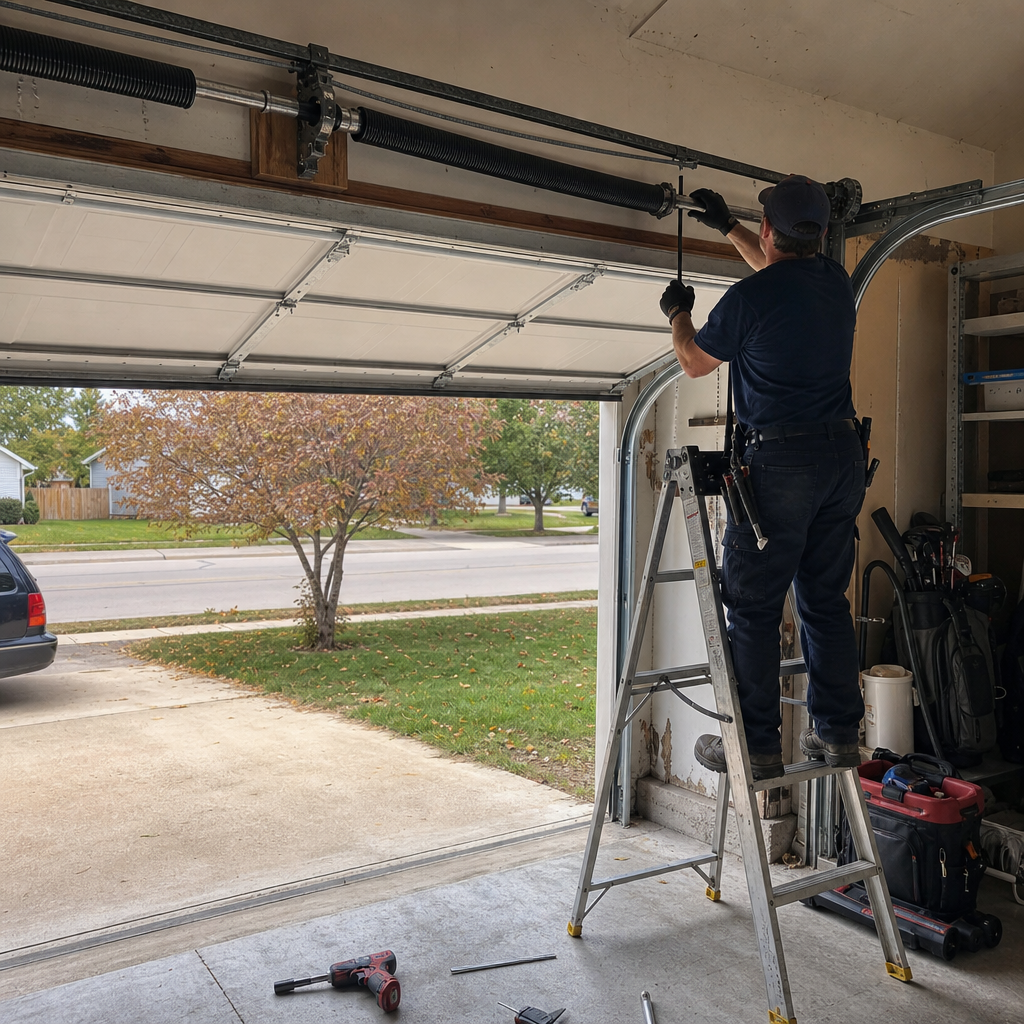
Why Your Garage Door Won’t Close in Dayton — And How to Tell If It’s a 5-Minute Fix or a Call-Now Problem
A garage door that won’t close usually points to one of two things: a safety sensor or opener logic issue (often fixable in minutes) or a mechanical obstruction or component failure that needs a technician. In Dayton, where freeze-thaw cycles from January through March regularly ice-lock door bottoms and crack weather seals, the distinction matters — because forcing a mechanically stuck door can snap a cable or buckle a panel. If you’re troubleshooting at night with an alley-access garage in neighborhoods like South Park or the Oregon District, knowing which category you’re dealing with determines whether you sleep soundly or need same-evening help. Call Pinnacle Garage Door Installation Greater Dayton at (833) 348-5999 if the situation feels beyond a quick check.
Sensor vs. Mechanical: The Two-Minute Test That Saves You a Headache
There’s a difference between a door that won’t close and a door that can’t close. One is a sensor or setting you might resolve in five minutes. The other means something is physically wrong, and forcing it risks real damage. Here’s how Charles and his team teach homeowners to tell them apart before anyone touches the opener.
Start with the manual override. Pull the red emergency release cord (usually a red handle hanging from the opener rail) and try lowering the door by hand. If it slides down smoothly and sits flush on the floor, the door’s mechanical path is clear — the problem lives in the opener’s logic, limits, or safety sensors. If it binds, grinds, or won’t move past a certain point, you’ve got a mechanical issue: track damage, roller seizure, spring imbalance, or something blocking the path.
This test is especially valuable in Dayton’s older housing stock, where garage door repair in Dayton often involves 40- to 70-year-old hardware that’s long past engineered service life. In Huber Heights’ brick ranch neighborhoods or Kettering’s mid-century builds, we’ve seen rollers seize inside brackets that haven’t been lubricated since the Carter administration. Forcing the opener to pull against that resistance doesn’t fix the problem — it strips the opener’s plastic gears or burns out the motor.
Reading Your Safety Sensors Like a Technician
Most modern openers use photoelectric sensors — small boxes mounted 4-6 inches off the floor on either side of the door opening, usually with LED indicators. These are the most common culprit when a door starts down, travels a few inches, then reverses — which is why we wrote a full guide on Why Does my Garage Door Reverse? (Dayton, OH). Here’s what the lights mean:
- Solid green and solid amber: The beam is uninterrupted. If the door still won’t close, the issue is likely in the opener’s limit settings or logic board — not the sensors themselves.
- Blinking amber (or blinking any color): Misalignment. The sending and receiving eyes aren’t looking directly at each other. Check for bumped brackets, loose wing nuts, or debris on the lenses. Dayton’s hard freeze-thaw cycles can shift sensor brackets mounted into aging concrete or wood trim.
- One or both sensors completely dark: Power or wiring issue. Trace the wires back to the opener head — we’ve found rodent damage in detached alley garages throughout Dayton’s urban core, where squirrels treat low-voltage wiring like a chew toy.
Realignment is straightforward: loosen the wing nut, pivot the sensor until the receiving eye shows solid light, then tighten. But if both LEDs are dark and the wiring looks intact, the problem likely needs a technician with a multimeter and replacement cable.
Dayton’s Most Common Winter Culprit: Ice, Seals, and Freeze-Lock
If your door closes partially then reverses — especially from January through March — don’t immediately blame the opener. Dayton’s Miami Valley position channels moisture and produces sharp freeze-thaw oscillations, with temperatures swinging from the teens to the mid-50s within days. This does specific damage that mimics sensor failure.
Check the bottom weather seal first. Freeze-thaw brittleness cracks Dayton seals faster than in drier inland markets. A cracked or missing seal lets water wick under the door bottom, where overnight refreezing welds the door to the concrete apron. The opener detects the resistance and reverses, exactly as it’s designed to do. We’ve responded to emergency calls in Oakwood and Belmont where the homeowner replaced sensors twice before realizing the door was frozen to the floor.
Look for ice buildup at the threshold. Ice storms — more common here than in Columbus to the east — routinely freeze door bottoms to concrete aprons overnight. If you see a rim of ice, don’t force the opener. Use a hair dryer or warm water to melt the bond, then operate the door manually to confirm free movement before reconnecting the opener.
Inspect the seal’s condition. A properly fitted seal compresses evenly across the full door width. If it’s cracked, flattened, or missing sections, replacement runs $110–$220 in the Dayton market — and prevents the freeze-lock cycle from repeating.
| Issue | Dayton-Specific Cause | Typical Repair Cost |
|---|---|---|
| Door reverses after partial close | Ice-locked bottom seal (winter) | $110–$220 (seal replacement) |
| Door won’t close, no sensor lights | Rodent-chewed wiring (alley garages) | $120–$240 (wiring repair) |
| Door heavy, won’t stay down manually | Broken torsion spring | $180–$340 |
| Opener runs, door doesn’t move | Stripped gears or carriage failure | $120–$320 (opener repair) |
| Track visibly bent or misaligned | Impact damage or hardware fatigue | $120–$240 (track realignment) |
When the Opener’s Logic Is the Problem — And What That Costs
If your manual-override test went smoothly — door lowers by hand, no binding — the problem is in the opener’s brain or settings. This is where brand-specific knowledge matters, and where Pinnacle’s hands-on experience with LiftMaster, Chamberlain, Genie, and Clopay systems pays off.
Travel limit misalignment is common after power outages or seasonal temperature swings that slightly shift door position. The opener “thinks” the door has reached the floor when it hasn’t, or tries to drive past the closed position. Most openers have limit adjustment screws or dials on the motor head — but here’s the catch: adjusting limits without understanding the door’s actual travel path can overdrive the mechanism and damage the top section or opener carriage. We see this most often on older Craftsman chain-drive units still running in Dayton’s postwar ranches.
Force sensitivity settings are another adjustment homeowners sometimes reach for. These control how much resistance triggers the auto-reverse. Turning them up to “fix” a door that reverses on a cold morning masks an underlying mechanical problem — worn rollers, binding track, or spring fatigue — and creates a safety hazard. A garage door should work so quietly you forget it’s there — that’s the whole point. If it’s fighting the opener, something needs fixing, not masking.
Logic board failure typically follows power surges or age-related component degradation. Symptoms include erratic behavior: door opens fine but won’t close, remote works intermittently, or wall button functions but remotes don’t. Board replacement runs $120–$320 depending on opener brand and age; for units over 12-15 years, full opener replacement at $250–$550 often makes more financial sense.
The Security Reality for Dayton’s Alley-Garage Neighborhoods
Here’s where our local geography changes the stakes. Dayton’s urban core — South Park, the Oregon District, St. Anne’s Hill, and similar neighborhoods — features a high concentration of detached garages accessed from alleys. A door stuck open overnight isn’t merely annoying; it’s an unsecured entry point for vehicles, tools, and anything else stored inside.
We’ve responded to emergency calls at 10 PM in these neighborhoods because the homeowner made a rational calculation: “I’ll troubleshoot in the morning” becomes untenable when the garage opens directly onto a dark alley. If your quick checks — manual override, sensor lights, ice inspection — don’t resolve the issue within 15 minutes, the pragmatic answer is to call for Emergency Garage Door Repair in Dayton, OH rather than leave the garage open overnight.
Pinnacle’s emergency availability exists precisely for this scenario. Charles Rodriguez and his team have handled after-hours calls in every neighborhood mentioned here, and the accountability structure is straightforward: the owner who built the company’s reputation is still the lead technician on the job, not dispatching from an office. Seventeen years, 1,186 reviews, one standard — we don’t leave a door unsecured overnight if we can help it.
What Pinnacle Garage Door Checks When We Arrive
Our diagnostic sequence builds on what you’ve already tested, but goes deeper:
- Confirm your manual-override finding. We operate the door by hand to feel for binding, imbalance, or rough spots in the track.
- Test spring balance. A properly balanced door stays put at any height when disconnected from the opener. If it drifts up or crashes down, the torsion spring system needs adjustment or replacement — a high-tension job that requires professional tools and training. Safety note: Never attempt to adjust or replace torsion springs yourself. These components store lethal energy and cause serious injury without proper equipment and technique. Always call a trained professional.
- Inspect rollers, hinges, and cables. We look for frayed cables, cracked rollers, and worn hinge points — especially critical on Dayton’s aging hardware.
- Verify sensor function with a multimeter. LED indicators can lie; we test actual voltage and signal continuity.
- Check opener force and limit calibration against door weight. We set these to manufacturer spec for your specific model, not generic defaults.
This systematic approach is why our garage door repair work maintains a 4.9-star average across nearly 1,200 verified reviews. We work on your brand — whether it’s a LiftMaster belt drive installed last year or a Wayne Dalton TorqueMaster system from the 1990s that most technicians won’t touch.
FAQs
Most repairs fall between $150 and $600, with the exact cost depending on what’s actually wrong. Sensor realignment or wiring repair typically runs $120–$240, opener logic board or limit adjustment $120–$320, and spring replacement $180–$340 if a broken torsion spring is causing the door to resist closing. We provide upfront pricing before any work begins — call (833) 348-5999 for a free estimate.
You can safely check three things: verify the safety sensors are aligned and lit, clear any visible obstructions from the track, and test whether ice has frozen the door bottom to the floor. If the door still won’t close after these checks, or if you suspect a spring, cable, or opener internal problem, call a professional — forcing the mechanism risks injury and costlier damage. For a door that won’t secure your property overnight, same-day service is available.
This usually means the opener’s safety system is detecting resistance — either from misaligned sensors, a physical obstruction, or the door binding in its track. In Dayton winters, check first for ice locking the door bottom or a cracked weather seal allowing water infiltration and refreezing. If the door moves freely by manual override but reverses with the opener, the issue is in the sensor beam, force settings, or limit calibration.
Repair is typically more economical for openers under 10 years old with isolated problems like limit misalignment, sensor wiring, or logic board failure — generally $120–$320. Full replacement at $250–$550 makes more sense for units over 12-15 years, those with multiple failing components, or when the brand is obsolete and parts are scarce. We’ll give you an honest assessment of both options after diagnosis.
When to Call Pinnacle Garage Door Installation Greater Dayton
If your garage door won’t close and the quick checks above haven’t solved it — or if you’re in one of Dayton’s alley-garage neighborhoods and can’t leave it open overnight — we’re available for same-day and Best Garage Door Repair in Dayton, OH. Charles Rodriguez, Owner & Lead Technician, brings 17 years of continuous trade experience and personal accountability to every job, backed by 1,186 verified reviews at a 4.9-star average.
We don’t upsell you on equipment you don’t need. We diagnose the actual problem, explain it in plain terms, and fix it right — whether that means a $130 sensor realignment or a full opener replacement. We’ve seen this before, and we know how to fix it right.
If you’d rather have it looked at, Pinnacle Garage Door Installation Greater Dayton offers a no-pressure assessment in Dayton — call (833) 348-5999.
Written by Charles Rodriguez, Owner & Lead Technician at Pinnacle Garage Door Installation Greater Dayton, serving Dayton, OH.