
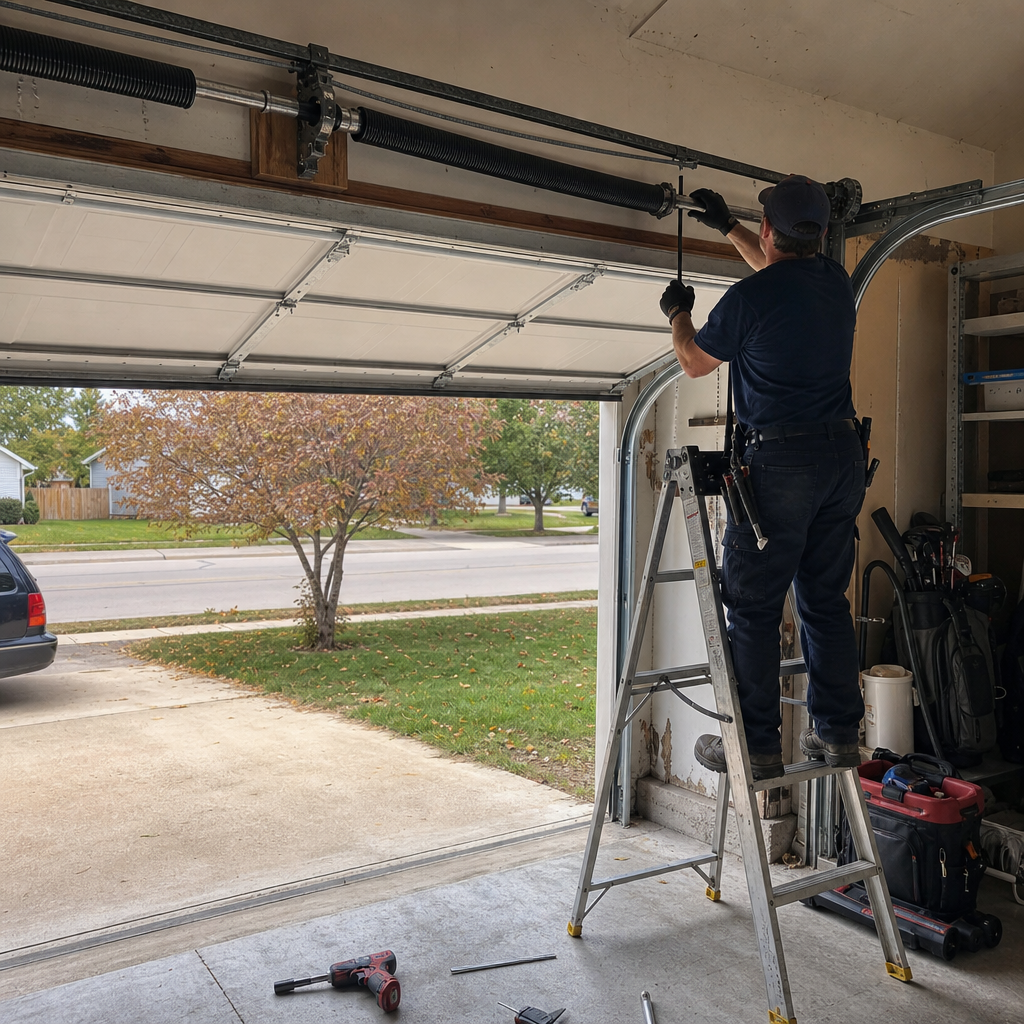
Why Does My Garage Door Reverse? The Dayton Homeowner’s Diagnostic Guide
Your garage door reverses because the opener’s safety system detects resistance or obstruction and automatically backs the door up to prevent damage or injury. In Dayton, the single most common cause we see from January through March isn’t a broken opener at all—it’s ice freezing the rubber bottom seal to your concrete apron, creating enough resistance that the down-force safety trigger reads it as a blocked path. If your door worked fine in fall and started reversing this winter, start by checking the floor, not the motor. For a same-day diagnosis anywhere in the Miami Valley, call Pinnacle Garage Door Installation Greater Dayton at (833) 348-5999.
Dayton’s Freeze-Thaw Reality: When Your Opener Is Actually Doing Its Job
Dayton’s position in the Miami Valley funnels moisture through the region and delivers those sharp freeze-thaw swings—teens one morning, mid-50s by Thursday—that fatigue hardware and create problems you won’t find in drier markets. Ice storms hit here harder than Columbus to the east, and when meltwater pools at your garage apron and refreezes overnight, it welds the rubber bottom seal to the concrete.
Here’s what happens: your opener’s down-force limit is calibrated to stop and reverse if it meets unexpected resistance. A frozen door bottom creates exactly that resistance. The opener isn’t malfunctioning—it’s protecting itself and anything in the door’s path. The dangerous mistake we see homeowners make is cranking up the down-force setting to power through the ice. That disables a safety feature designed to protect children, pets, and vehicles, and it doesn’t solve the actual problem.
What to check first:
- Look for a visible ice line or frost buildup where the rubber seal meets the concrete
- Listen for a “stuck” sound in the first 6–12 inches of downward travel before the reversal
- Test the door manually: disconnect the opener (pull the red release handle), lift the door halfway, and see if it moves freely or hangs up at the bottom
If ice is the culprit, a plastic scraper and a small amount of calcium chloride (not rock salt, which corrodes aluminum track) usually frees it. But if this is a recurring problem, the seal itself may be cracked and holding moisture—something we replace regularly in Dayton’s older housing stock.
Photo-Eye Sensors: The Usual Suspect, But Not the Only One
When a door reverses and ice isn’t the issue, misaligned or dirty photo-eye sensors are the next most common cause. These infrared eyes sit 4–6 inches off the floor on either side of the door opening and send an invisible beam across. Break that beam, and the opener reverses automatically.
In Dayton, we see three sensor-specific problems that generic troubleshooting guides miss:
1. Road salt spray on the lens. Our winters mean plowed roads and salted driveways. Wind blows that residue into garages, and a thin film of salt crust on a sensor lens scatters the infrared beam just enough to cause intermittent reversals. Wipe both lenses with a damp cloth—not a dry rag that can scratch the plastic.
2. Cold-temperature wiring pinches. Vinyl-jacketed sensor wiring gets stiff in freezing temperatures. If it’s routed through a tight staple or clip, contraction can pull the connection loose or create an internal break that reads as a beam interruption. This is especially common in detached alley-access garages throughout Dayton’s urban core, where wiring runs are longer and less protected.
3. Physical misalignment from track vibration. Dayton’s mid-century housing stock includes a lot of 40–70-year-old hardware. Worn rollers and loose track mounts vibrate more than modern systems, and that vibration gradually knocks sensor brackets out of alignment. If both sensor LEDs aren’t steadily lit (one amber, one green on most LiftMaster and Chamberlain systems), realignment is needed.
Sensor realignment is a safe homeowner fix. Follow the manufacturer’s procedure for your brand—usually loosening the bracket wingnut, adjusting until both LEDs hold steady, and retightening. If you can’t get both lights solid, the wiring or a sensor itself may need replacement.
Force Settings: When Adjustment Helps—and When It Hides a Bigger Problem
Every opener has two force-limit adjustments: up-force and down-force. These tell the motor how much resistance is normal versus “something’s wrong, reverse now.” In Genie and Raynor systems, these are typically screw dials on the motor housing; in newer LiftMaster models, they’re digital settings accessed through the wall control or app.
A properly calibrated door in good condition needs minimal down-force to close completely. If you’ve gradually had to increase that setting over time, something mechanical is degrading—not the opener’s sensitivity. Common culprits in Dayton homes:
| Problem | What It Feels Like | Typical Repair Range |
|---|---|---|
| Worn rollers binding in track | Door labors or “catches” at same point every cycle | $110–$220 (roller replacement) |
| Track section pitted or misaligned | Visible gap between roller and track; grinding sound | $120–$240 (track realignment) |
| Spring fatigue (torsion or extension) | Door feels heavy manually; opener strains | $180–$340 (spring repair) |
| Hinge seized or bent | Visible gap at panel joint; door bows slightly | $150–$600 (general repair) |
Critical safety note: Torsion springs are under extreme tension and can cause serious injury or death if handled improperly. If spring fatigue is suspected, stop using the door and call a professional. This is not a DIY repair.
Charles Rodriguez, our Owner and Lead Technician, has seen too many homeowners “solve” a frozen-door reversal by maxing out down-force, then call us weeks later when the same degraded roller or spring finally fails completely—often with more damage and a higher repair bill. Garage Door Repair isn’t about masking symptoms; it’s about finding what’s actually wrong.
The Travel Pattern Tells the Story: A Diagnostic Heuristic
After 17 years and 1,186 verified reviews at a 4.9-star average, we’ve learned that where and when a door reverses reveals the cause faster than any tool. Use this framework before deciding whether to troubleshoot or call:
Reverses at the same point every time? This is mechanical. Worn rollers, a bent track section, or a failing hinge create consistent resistance at a specific location. The opener’s logic doesn’t change; the physical obstruction does. Inspect the track and rollers at that exact height, or have us do it—this is our standard diagnostic on every Garage Door Repair in Dayton call.
Reverses inconsistently or only in cold weather? This is environmental or sensor-related. Ice bonding, salt-fogged lenses, or contracted wiring create intermittent or temperature-dependent failures. Start with the sensor cleaning and ice check described above.
Reverses immediately on touching down, with no visible obstruction? Check for debris on the floor (a leaf, a tool, a chunk of ice), a damaged bottom seal bulging downward, or—less commonly—a cracked concrete apron with a raised edge that’s new since last season.
Reverses randomly mid-travel in warm weather? Likely electrical: failing circuit board, intermittent wiring short, or—in older Craftsman and Wayne Dalton openers—a worn logic board that responds to voltage fluctuations. Dayton’s summer thunderstorms and grid variability can aggravate this.
When to Call, When to Wait, and What It Costs
We’re straightforward about this: some reversal causes are safe to address yourself, and some aren’t. Here’s where we draw the line based on what’s actually dangerous versus merely inconvenient.
Safe homeowner fixes: Ice removal from the apron, sensor lens cleaning, sensor realignment (if you can get both LEDs steady), and visual track inspection for obvious debris.
Call a professional: Any adjustment to force settings if you don’t know the manufacturer’s baseline; any suspected spring, cable, or roller issue; any electrical diagnosis beyond “try unplugging it for 30 seconds.” Torsion springs, in particular, store enough energy to maim or kill—this is not exaggeration, it’s physics.
Our diagnostic service call in Dayton runs within our standard $150–$600 repair range, with most common reversal fixes (sensor replacement, track realignment, roller swap) falling in the lower half. We quote upfront before any work begins, and estimates are free if you proceed with the repair.
Same-day and Emergency Garage Door Repair in Dayton, OH is available for doors stuck open or unsecured—situations where a reversal has left your garage exposed. We work on your brand, whether it’s a LiftMaster belt drive in a Kettering ranch or a vintage Raynor chain system in an Oregon District carriage house.
FAQs
The most likely cause is a misaligned or dirty photo-eye sensor, but in Dayton winters, ice freezing the bottom seal to the concrete apron is equally common and often overlooked. Check for frost or ice at the floor first, then clean both sensor lenses and verify both LEDs are steadily lit. If the problem persists, the wiring or a sensor may need replacement—call (833) 348-5999 for a free estimate.
Repair is almost always cheaper: opener repair runs $120–$320 versus $250–$550 for new opener installation, and most reversal issues are sensor, force-setting, or environmental problems—not motor failure. Replacement only makes sense if the opener is 15+ years old, lacks modern safety features, or has repeated circuit board failures. We diagnose first and recommend honestly; our 4.9-star average across 1,186 reviews exists because we don’t sell people hardware they don’t need.
Yes—same-day service is available for reversal issues throughout Dayton and the Miami Valley, including emergency response for doors stuck open or unsecured. We stock sensors, rollers, cables, and hardware for all eight major brands we service, so most repairs complete in a single visit. Call (833) 348-5999 to check current availability; we’ll give you a straight answer about timing, not a runaround.
Most reversal repairs in Dayton fall between $120 and $340, depending on whether the fix is sensor realignment, sensor replacement, roller replacement ($110–$220), or Garage Door Off Track Repair in Dayton, OH ($120–$240). Our full repair range is $150–$600 for more complex issues like spring or cable work. We provide upfront pricing before any work begins, and estimates are free—call (833) 348-5999 to schedule.
What “Fixed Right” Actually Means
A garage door should work so quietly you forget it’s there—that’s the whole point. When a door reverses repeatedly, it’s not just annoying; it’s your system telling you something is wrong, and the message matters.
Charles Rodriguez, our Owner and Lead Technician, grew up in Dayton’s Five Oaks neighborhood and has spent 17 years learning what this city’s particular combination of mid-century housing stock, Miami Valley moisture, and freeze-thaw cycles does to garage doors. He’s the one who answers the phone at odd hours, who still climbs ladders on installs, and whose daughter now shadows him on weekend jobs—”either a sign I’ve done something right or that she has nowhere better to be, probably both.”
That direct accountability—one technician-owner, one standard, 1,186 reviews proving it isn’t a claim—is what separates Pinnacle from the franchise chains that rotate crews through town and the one-man shops that can’t stock parts for eight brands or respond same-day.
If you’d rather have it looked at, Pinnacle Garage Door Installation Greater Dayton offers Best Garage Door Repair in Dayton, OH with a no-pressure assessment—call (833) 348-5999 for a free estimate and straight answers about what’s actually causing your door to reverse.
Written by Charles Rodriguez, Owner & Lead Technician at Pinnacle Garage Door Installation Greater Dayton, serving Dayton, OH.