
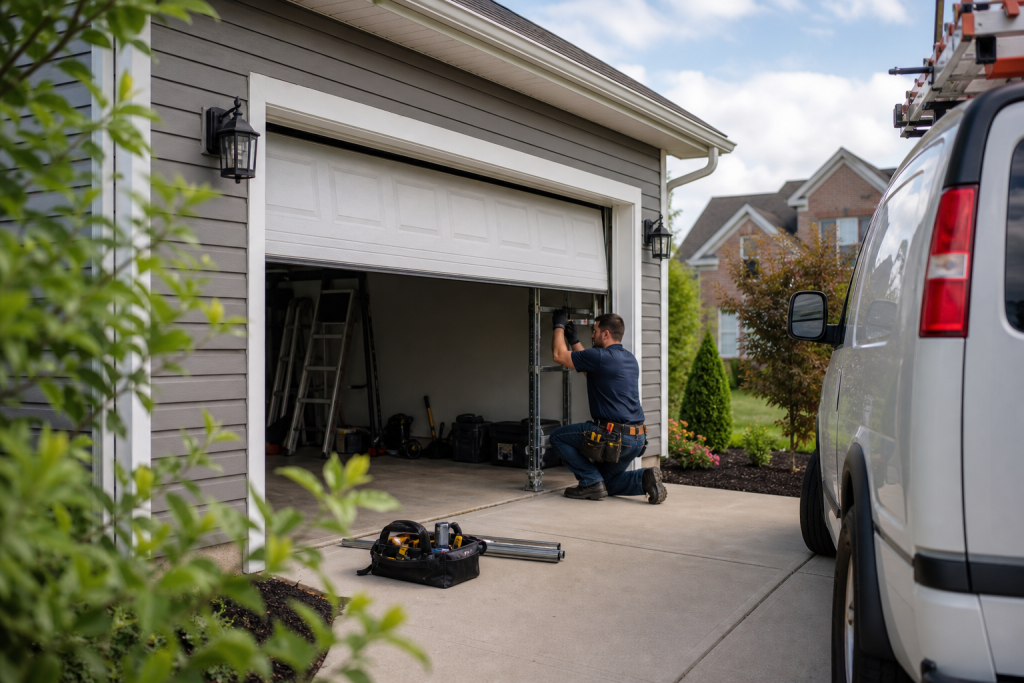
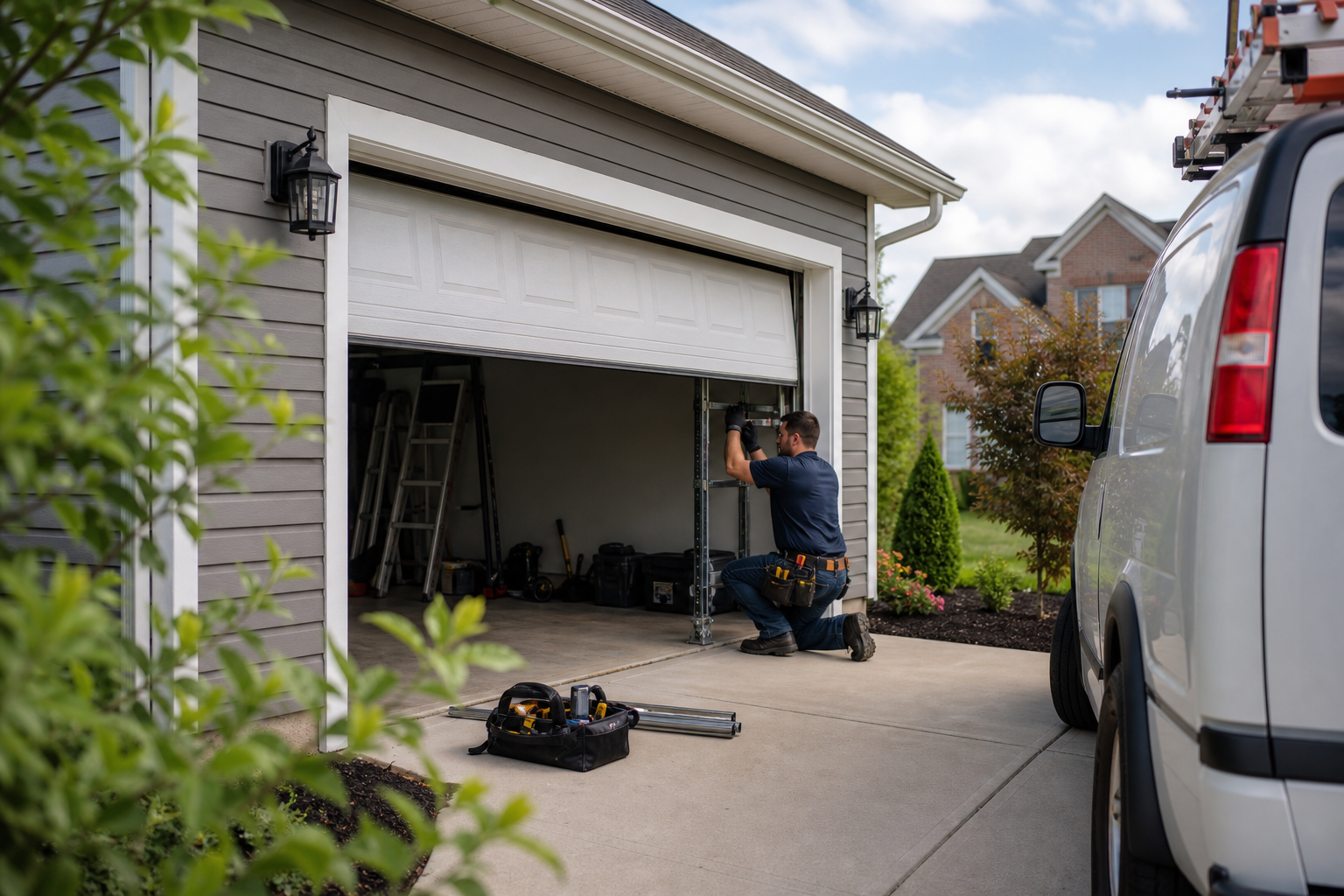
LiftMaster Garage Door Repair in Dayton: A Homeowner’s Guide
LiftMaster garage door opener repair in Dayton typically runs $150–$400 depending on whether you’re dealing with a failed logic board, worn gear assembly, or myQ connectivity issue. Most repairs are completed same-day, and many problems can be diagnosed in minutes using the opener’s built-in LED error code system. If you’d rather not troubleshoot yourself, our Dayton repair team is available for emergency service — call (833) 348-5999.
Here’s something most homeowners don’t realize: your LiftMaster myQ-connected opener has already logged the error code before you’ve finished calling for help. That little flashing LED on the motor housing isn’t just decoration — it’s a diagnostic tool that separates a 20-minute fix from a 2-hour guessing game. We’ve been repairing LiftMaster systems across Dayton for 17 years, and the gap between technicians who know how to read those codes and those who don’t is wider than most customers ever know until they’re paying for a second visit.
How to Read LiftMaster Diagnostic Codes Before Calling a Tech
Every LiftMaster opener manufactured since 2010 has a diagnostic LED near the “Learn” button. The pattern of flashes tells you exactly what’s wrong — if you know the language.
Here’s what we see most often in Dayton homes:
- 1 flash: Safety sensor misalignment or obstruction. Check for spider webs, leaves, or a bumped sensor bracket. Dayton’s mature tree canopy in neighborhoods like Oakwood and Kettering means debris finds its way into garages year-round.
- 2 flashes: Short in the wiring or safety sensor wire disconnected. Often follows a DIY storage project where someone snagged a wire.
- 4 flashes: Misaligned or obstructed safety sensors — different from 1 flash in that the sensors are physically blocked, not just misaligned.
- 5 flashes: Motor overheated or RPM sensor failure. Common in summer when Dayton hits 90°F+ and garages become ovens. The motor thermal protector trips to prevent damage.
- Up arrow flashes once, down arrow flashes twice: Force settings need adjustment — usually after a door spring has weakened and the opener is working harder to lift the same load.
The myQ-enabled models (8550W, 84501, 87504-267) add a second layer: the myQ app itself will push error notifications if the Wi-Fi hub is connected. We’ve had Dayton customers call us convinced their opener was dead, when the app showed a simple “force exceeded” alert from a frozen bottom seal. A quick threshold adjustment, no parts needed.
One caveat: if you’re seeing repeated overheating codes (5 flashes) or the motor hums but won’t move, the RPM sensor or capacitor may have failed. These involve live electrical components and stored tension in the door system. That’s when to step back and call a pro.
When to call a pro: Any error involving electrical components, motor replacement, or if the door won’t stay closed — that’s a security issue, especially in Dayton’s older neighborhoods where detached garages face alleys.
Opener Repair vs. Door System Repair: Knowing Where the Problem Lives
This distinction costs Dayton homeowners hundreds in unnecessary service calls every year. The opener and the door are two separate mechanical systems that happen to work together. Misdiagnosing which one failed leads to replacing the wrong part — or worse, replacing a part that was never the root cause.
Signs it’s the opener: Motor runs but door doesn’t move; grinding noise from the opener housing; remote works intermittently but wall button works fine; LED shows diagnostic codes; myQ app shows “disconnected” when the opener has power.
Signs it’s the door system: Door is heavy to lift manually (disconnect the opener arm and try — if it won’t stay at half-open, your springs are failing); visible gaps in torsion springs; rollers off track; cables frayed or loose; door binds in the tracks.
Here’s the critical part: a failing spring forces the opener to work at 2-3x its designed load. The opener’s gear assembly strips, the motor overheats, and you get a $350 opener repair that should have been a $220 spring replacement. We’ve seen this exact sequence in Dayton’s 1960s ranch neighborhoods — Belmont, Patterson Park, parts of Riverside — where original doors are still in service with 20-year-old springs.
Charles and his team always test the door balance before quoting any opener work. It’s a 30-second check that prevents the callback no customer wants and no honest technician wants to make.
Related services in Dayton: If your door itself is the problem, see our full guide to garage door repair in Dayton or new door installation options.
myQ Issues That Look Like Opener Failures (But Aren’t)
Since Chamberlain (LiftMaster’s parent company) pushed myQ connectivity into nearly every residential opener after 2018, we’ve seen a new category of “opener failures” that are actually network or software problems. The opener itself is fine. The door works from the wall button. But the app won’t connect, schedules won’t run, or the opener “disappears” from the myQ ecosystem.
Common myQ-specific issues in Dayton:
- Wi-Fi signal degradation: Dayton’s older homes with plaster-and-lath walls or aluminum siding create dead zones. The myQ hub needs -70 dBm or better. We carry Wi-Fi extenders rated for garage environments — temperature swings, dust, vibration.
- Router firmware conflicts: Certain ISP-provided routers (common in Dayton’s fiber rollout areas) block myQ’s cloud handshake after automatic updates. The fix is usually a port configuration, not a new opener.
- myQ app version mismatch: Chamberlain pushes firmware updates to openers automatically, but the phone app doesn’t always auto-update. A 2023 opener running current firmware won’t pair with a 2022 app version.
- Account migration errors: When Chamberlain migrated myQ to the new platform in 2024, some Dayton customers lost device associations. The opener works locally, but cloud features fail.
The diagnostic tell: if the wall button and remotes work normally, but app features fail, you’re looking at a logic board or connectivity issue — not a motor or drive system failure. Repair cost drops from $300+ to typically $80–$150 for Wi-Fi diagnostics and reconfiguration, or $200–$280 if the logic board needs replacement.
We pulled one out of a garage over in Beavercreek last month where the homeowner had been quoted a full opener replacement for a “dead myQ system.” Turned out to be a failed 2.4GHz band on their router — 20 minutes, no parts, problem solved. That’s the difference between a technician who knows the ecosystem and one who knows only how to swap boxes.
LiftMaster Warranty Coverage: What Protects Your Repair (and What Voids It)
LiftMaster’s residential warranty runs 1 year on accessories, 3 years on the motor and belt/chain, and lifetime on the motor for premium models (8550W, 8500W). But coverage has strict conditions that Dayton homeowners routinely forfeit without knowing.
Warranty stays valid if: Original purchaser owns the home; repair uses LiftMaster-certified parts; work is performed by an authorized dealer or the homeowner (for simple adjustments); registration is completed at myliftmaster.com.
Warranty voids if: Non-LiftMaster parts are installed; the opener is moved to a new home; damage results from improper door balance or spring failure; unauthorized modification (including third-party smart home adapters); water damage or pest infestation.
Here’s the Dayton-specific angle: our freeze-thaw cycles and humid summers stress door components faster than the national average. A spring that fails in year 4 due to metal fatigue can overload the opener and void the motor warranty — even though the spring isn’t a LiftMaster part. We’ve documented this with customers in Centerville and Springboro who assumed the opener warranty would cover everything.
Before any repair, we verify warranty status. If your 8550W is 18 months old with a motor issue, that repair might be $0 parts through LiftMaster. If you’ve already had a handyman install generic sensors, we need to know — because continuing with non-certified parts kills any remaining coverage.
We don’t sell LiftMaster exclusively — we work on your brand, whether it’s Chamberlain, Genie, Craftsman, or Raynor. But when you do own a LiftMaster, we make sure you don’t leave warranty money on the table.
Dayton’s Most Common LiftMaster Models by Era — and Their Known Wear Patterns
Walk through any Dayton suburb and you’ll find three distinct generations of LiftMaster openers, each with predictable failure modes based on age and local conditions.
Pre-2012 chain drives (139.53985, 3280): Still running in neighborhoods like Belmont and Walnut Hills where original equipment outlasted the house’s first owner. The chain stretches, the gear sprocket wears to a point where it skips, and the capacitor fails after 10–12 years. These are straightforward repairs — if the rail assembly isn’t rust-seized from Dayton road salt tracked into the garage.
2012–2018 belt/chain hybrids (8355, 8360, 8550): The transition to DC motors and soft-start/stop programming. The belt itself rarely fails, but the trolley carriage wears where it grips the belt. We see this in Kettering and Oakwood homes where daily use is high. The 8550’s battery backup system also has a 3–4 year battery life — shorter if the garage isn’t climate-controlled.
2018+ myQ-enabled DC models (84501, 87504-267, 8587W): Smarter, quieter, more complex. The logic boards handle Wi-Fi, encryption, and motor control — one failure mode, three symptoms. The integrated LED lighting on 87504 models has a known driver failure around year 5. And the force-sensing calibration drifts in Dayton’s temperature swings, causing false “obstruction detected” errors on cold January mornings.
Our 17 years in the trade means we’ve watched this evolution in real time. We know which models had production runs with weak capacitors, which logic board revisions fail first, and which “improvements” created new problems. That’s not information you’ll find in a manual — it’s the accumulated pattern recognition from 1,186 jobs, 1,186 reviews, one standard.
The Bottom Line
LiftMaster builds reliable openers, but reliability depends on matching the right repair to the right problem. Dayton’s climate, housing stock, and myQ-connected expectations create a repair environment where generic garage door knowledge isn’t enough — you need brand-specific diagnostic skill and the honesty to fix the root cause, not just the symptom.
Key takeaways:
- Check your opener’s LED flashes before calling — you might save a service fee with a 2-minute sensor realignment
- Always test door balance manually; spring failure masquerades as opener failure
- myQ connectivity issues are usually network or software, not hardware — know which before authorizing work
- Verify warranty status before any repair; LiftMaster coverage is generous but easily voided
- Dayton’s temperature extremes accelerate wear; model-specific knowledge prevents repeat failures
If you’re in Dayton and your LiftMaster isn’t behaving right — whether it’s flashing error codes, dropping off the app, or just making sounds it didn’t used to — Pinnacle Garage Door Installation Greater Dayton offers free estimates. Charles Rodriguez still runs every job as Lead Technician, and we’ve got 17 years, 1,186 reviews, and one standard to uphold. Call (833) 348-5999.
Frequently Asked Questions
Most LiftMaster repairs in Dayton fall between $150 and $400. Sensor realignment or force adjustment runs $100–$150. Gear assembly replacement is $180–$280. Logic board replacement ranges $250–$400 depending on model. Motor replacement on premium units can reach $450–$650, though we often recommend evaluating full opener replacement at that point. Call (833) 348-5999 for an exact quote — estimates are free.
Yes, same-day service is available for most LiftMaster issues in Dayton and surrounding areas. Emergency garage door service is also available for doors stuck open or security-compromised situations. We stock common LiftMaster parts including logic boards, gear kits, safety sensors, and remotes. Call (833) 348-5999 to check current availability — we’ll give you a realistic arrival window, not a vague “sometime today.”
Repair makes sense when the opener is under 10 years old, the motor runs smoothly, and the failure is isolated to one component — sensor, gear, or logic board. Replacement becomes the better value when the opener is 12+ years old, has multiple failing components, or lacks modern safety features. In Dayton’s market, a quality replacement opener with professional installation runs $450–$850 installed. We’ll tell you honestly which path saves money long-term. Call (833) 348-5999 for a no-pressure assessment.
This usually indicates a remote-specific problem rather than opener failure. Most common causes: remote battery depleted (replace with CR2032); remote needs reprogramming after power outage; remote’s frequency interfered by LED bulbs in the garage (a known LiftMaster issue with certain bulb brands); or the remote itself has failed after physical damage. Try reprogramming first — hold the Learn button until the LED glows, then press your remote button within 30 seconds. If multiple remotes fail while the wall button works, the logic board’s radio receiver may need replacement. Call (833) 348-5999 if basic troubleshooting doesn’t resolve it — we’ll diagnose whether it’s a $12 battery or a $280 board.
Written by Charles Rodriguez, Owner & Lead Technician at Pinnacle Garage Door Installation Greater Dayton, serving Dayton since 2009.
Need Garage Door Help?
Call Pinnacle Garage Door Installation Greater Dayton — licensed & insured, here with fast after-hours help in Dayton.
(833) 348-5999