
Last updated July 10, 2026
Seasonal Garage Door Care for Dayton: Year-Round Homeowner’s Guide
Spring is when Dayton’s phone lines light up with broken torsion springs — but the stress that snapped them built up over three months of sub-freezing temperatures. The fix window was November. Most homeowners treat garage door maintenance like a tax deadline: something to panic about once a year. That’s backwards. Dayton’s four genuinely distinct seasons don’t just change the weather — they change the failure modes your garage door faces. A single annual tune-up misses most of them. In this guide, we’ll map specific maintenance tasks to specific months so you’re working ahead of the season that causes the damage, not scrambling after it.
Quick Answer
Seasonal garage door care in Dayton means four targeted maintenance windows: fall prep for freeze-thaw stress (October–November), winter monitoring for motor strain and ice damage (December–February), spring inspection for freeze-thaw damage reveal (March–April), and summer weatherstripping and humidity checks (June–August). A 15-minute seasonal check prevents the emergency repairs that spike our call volume every March and January in Dayton.
Table of Contents
- Why November Is the Most Important Month for Dayton Garage Doors
- Winter-Specific Issues: Cold Snaps and Opener Motor Strain
- Spring Inspection: What Freeze-Thaw Cycles Actually Damage
- Summer Humidity and Weatherstripping Degradation
- Building a 15-Minute Seasonal Check Into Your Routine
- Common Mistakes to Avoid
- When to Call a Professional
- Frequently Asked Questions
Why November Is the Most Important Month for Dayton Garage Doors
We’ve been tracking this for 17 years: our emergency call volume in Dayton drops by roughly 40% for homeowners who do their maintenance in November versus those who wait until March. The reason is simple physics. Dayton’s average first freeze hits in late October, and by mid-November we’re seeing overnight lows in the mid-20s. Every component that will fail in January or February is already showing stress by then — you just can’t see it yet.
Torsion springs are the clearest example. These tightly wound steel coils operate under immense tension, and cold makes steel brittle. A spring that’s micro-fractured from summer heat cycles will hold through fall, then snap on the first sub-20-degree morning in January. In our experience across Dayton neighborhoods from Oakwood to Kettering, the springs that fail in January were already compromised by November 15th.
Here’s the exact sequence we recommend for fall prep:
- Visual spring inspection: Look for gaps between coils when the door is closed, rust flakes at the spring ends, or a slight tilt in the door when it’s halfway open. These are pre-failure indicators that only a trained eye catches early — which is why Charles and his team build this into every fall service call.
- Lubricate all moving parts with silicone-based grease: Avoid WD-40; it attracts grit. Dayton’s fall wind carries particulates from harvested fields that accelerate wear on sticky surfaces.
- Test door balance: Disconnect the opener and lift manually. A properly balanced door stays at any height. If it drifts down, the springs are weakening.
- Inspect weatherstripping for daylight gaps: Dayton’s fall temperature swings — 70 degrees one day, 35 the next — harden rubber seals prematurely. Replace if you see cracking or compression set.
- Check safety sensors and auto-reverse: Fall leaf debris and shorter daylight hours mean more nighttime entries. Place a 2×4 on the ground; the door should reverse on contact.
- Clear and test the emergency release: Dayton’s first ice storm often coincides with power outages. Verify the red handle moves freely.
The November window matters because it catches problems in their “expensive but manageable” phase, before they become “emergency call at 6 AM with a car trapped inside” phase. We’ve seen this pattern repeat across our 1,186 reviews — the homeowners who mention “caught it early” almost always mention fall timing.
Winter-Specific Issues: Cold Snaps and Opener Motor Strain
Dayton’s winter temperatures average 22–32°F, but the killers are the cold snaps: January nights at -5°F to 5°F that stress every system simultaneously. Most homeowners don’t realize their garage door opener works harder in winter than any other season.
Here’s what happens. Cold thickens lubricants, stiffens weatherstripping, and contracts metal tracks. The opener motor — whether it’s a Chamberlain belt-drive, a Genie screw-drive, or a chain system — draws up to 40% more amperage to move the same door. That extra load burns out capacitors and strips nylon gears, especially in openers older than eight years. We replace more opener motors in January and February than in all other months combined.
If your garage is attached to your Dayton home, set your thermostat no lower than 55°F in adjacent spaces. This isn’t about comfort — it’s about thermal mass. An attached garage shares at least one wall with conditioned space. When that wall drops below 45°F, the temperature differential creates condensation on the door’s interior hardware, which freezes overnight and locks rollers in place. We’ve freed more frozen rollers in Beavercreek and Centerville homes from this exact cause than from any other winter issue.
Winter monitoring checklist:
- Listen for opener strain: A healthy opener hums; a struggling one grinds or labors. If the light flickers during operation, the motor is drawing near-maximum amperage.
- Check for ice at the door base: Dayton’s freeze-thaw cycles create ice dams under weatherstripping. Chip carefully — never pry with tools that damage the seal.
- Verify manual operation monthly: Disconnect the opener and lift by hand. If it’s noticeably harder than in fall, something’s binding — likely a track misalignment from thermal contraction.
- Inspect cables for fraying: Cold-brittle cables snap without warning. Look for unwinding strands, especially near the bottom bracket where moisture collects.
Safety note: Garage door cables and torsion springs are under lethal tension. A frayed cable or cracked spring can cause serious injury or death if handled improperly. If you see damage, stop using the door immediately and call a trained technician. This isn’t a DIY repair — we’ve seen the aftermath of well-intentioned homeowners who learned this the hard way.
Spring Inspection: What Freeze-Thaw Cycles Actually Damage
March is our busiest month in Dayton, and it’s not because doors suddenly break — it’s because damage from three months of freeze-thaw finally becomes impossible to ignore. The inspection you do in March isn’t about preventing winter damage; it’s about catching what winter already did before it cascades into secondary failures.
Freeze-thaw damage in Dayton operates on a specific mechanism. Water enters micro-cracks in concrete, brick, and yes, metal components during warm spells. When temperatures drop 30–40 degrees overnight — common in Dayton’s shoulder seasons — that water expands by 9%. Repeat that cycle 50 times per winter, and you’ve got material fatigue that shows up as:
- Track misalignment: The vertical tracks are anchored to jambs that shift with thermal expansion. By March, we commonly find 1/4-inch gaps between track and jamb in Dayton’s older homes, especially in neighborhoods like Belmont and Linden Heights with pre-1980 construction.
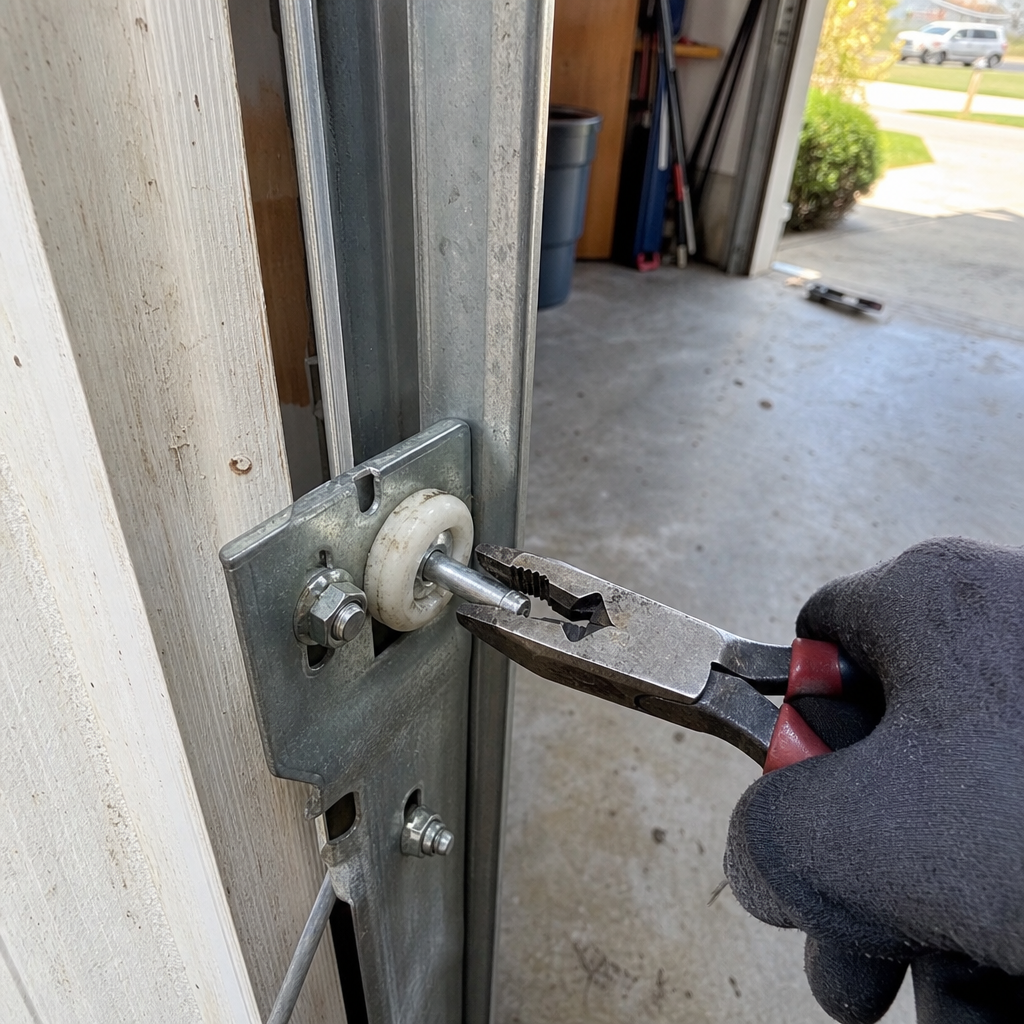
- Roller wear: Steel rollers develop flat spots from binding; nylon rollers crack from cold brittleness then shatter when spring warmth returns flexibility.
- Hinge pin elongation: The holes in stamped-steel hinges oval out from repeated stress, causing door sections to sag and bind.
- Opener rail flex: The header bracket loosens as the framing cycles, creating a visible bow in the rail during operation.
Our spring inspection protocol, developed over 17 years and thousands of Dayton jobs:
- Run the full cycle and watch for section binding: A door that “walks” side-to-side has hinge or track issues.
- Measure track plumb with a level: Should be within 1/4 inch over the full height. Dayton’s clay soils shift more than people realize.
- Inspect every roller for rotation: A roller that doesn’t spin freely is either worn or binding in a distorted track.
- Check all fasteners for looseness: Vibration plus thermal cycling backs out lag screws. We find loose operator brackets on roughly 30% of spring inspections.
- Test force settings on the opener: If the opener was adjusted for winter stiffness and not reset, it’ll slam the door in spring — damaging everything downstream.
The Clopay and Amarr doors we service most commonly in Dayton both use proprietary hinge designs that fail predictably at the 12–15 year mark in this climate. If your door is in that range and showing any of these symptoms, spring inspection is decision time: targeted repair or full replacement before the failures compound.
Summer Humidity and Weatherstripping Degradation
Dayton’s July and August average 70–75% relative humidity, with dew points that make garage interiors feel like storage lockers. This isn’t just uncomfortable — it’s actively degrading components that winter will then exploit.
Wood doors, still common in Dayton’s historic districts like Oregon District and St. Anne’s Hill, absorb moisture and swell. A door that fit perfectly in May binds by August. Homeowners respond by adjusting opener force settings, which then over-stresses the system when the door shrinks in October. We’ve replaced openers that were actually fine — the real problem was seasonal wood movement that should’ve been managed at the door, not the operator.
Weatherstripping degradation is the hidden summer killer. Dayton’s UV index peaks in June–July, and direct south-facing garage doors see rubber seals oxidize and crack in a single season. By fall, that compromised seal is letting in moisture that freezes against the door bottom, gluing it to the threshold. The opener strains, the door warps, and the homeowner calls us in January with a multi-component failure that started with a $15 seal in July.
Summer maintenance tasks:
- Check wood door panels for finish failure: Any bare wood is absorbing moisture. Spot-seal with exterior-grade polyurethane.
- Inspect weatherstripping for UV damage: Look for surface cracking, color fading from black to gray, or loss of elasticity. Replace proactively — don’t wait for leaks.
- Verify drainage away from door threshold: Dayton’s summer thunderstorms dump water fast. If it pools at the door base, it’ll wick into the seal and accelerate degradation.
- Test opener force settings: A door that bound in humidity and was “fixed” with force adjustment needs resetting before fall contraction begins.
- Lubricate again: Summer heat thins lubricants; reapply before they run off onto vehicles or storage.
The Genie and Chamberlain openers we work on most frequently have force-setting procedures that differ by model year — one more reason the “we work on your brand” approach matters. A 2018 Chamberlain requires a different sequence than a 2023 model, and getting it wrong either leaves the door unsafe or overworks the motor. Charles and his team carry the full protocol library for all eight brands we service.
Building a 15-Minute Seasonal Check Into Your Routine
The reason most maintenance gets skipped isn’t laziness — it’s friction. A “project” gets deferred indefinitely; a “habit” gets done. Here’s how to embed a 15-minute seasonal check into something you already do.
Link it to an existing seasonal task:
| Season | Anchor Task | Garage Door Check |
|---|---|---|
| Fall | When you winterize outdoor faucets | Run the November prep sequence |
| Winter | When you check furnace filters monthly | Test manual door operation |
| Spring | When you change smoke detector batteries | Run the March inspection protocol |
| Summer | When you service lawn equipment | Check weatherstripping and wood finish |
The 15-minute structure:
- Minutes 1–3: Visual sweep — springs, cables, rollers, tracks, weatherstripping. Look for what’s changed since last season.
- Minutes 4–8: Operational test — full up/down cycle, manual disconnect test, safety sensor check, auto-reverse with 2×4.
- Minutes 9–12: Lubrication touch-up — rollers, hinges, springs, operator rail. Wipe excess.
- Minutes 13–15: Log and schedule — note anything that changed, set reminder for next season, call for service if needed.
We’ve seen this habit work across Dayton’s diverse housing stock, from 1920s bungalows in Walnut Hills to new construction in Washington Township. The common factor isn’t the house — it’s the homeowner who treats garage door care as seasonal infrastructure maintenance, not a repair emergency waiting to happen.
17 years, 1,186 reviews, one standard: the door works when you need it, every season, without drama. That’s what this routine delivers.
Common Mistakes to Avoid
- Using WD-40 as garage door lubricant: It’s a solvent, not a lubricant, and it attracts Dayton’s airborne grit like a magnet. Within two months, you’ve got grinding paste instead of smooth operation. Use silicone-based or lithium-based products designed for door systems.
- Ignoring the door until it makes noise: By the time a garage door is audibly complaining, damage is already done. Dayton’s freeze-thaw cycles accelerate wear silently; the noise is the endpoint, not the warning.
- Adjusting opener force to compensate for mechanical problems: This masks symptoms while destroying the opener. We’ve replaced $400 openers that were sacrificed to avoid a $120 roller replacement. Fix the mechanical issue first.
- Skipping fall prep because the door “worked fine last winter”: Last winter’s mild temperatures don’t predict this winter’s cold snaps. Dayton’s January lows vary by 20 degrees year to year, and one brutal week is all it takes to finish a compromised spring.
- DIY spring or cable replacement: The torsion springs on a standard residential door store enough energy to cause fatal injury. We’ve responded to emergency calls where homeowners were lucky to escape with bruises. This is never a DIY project in any season.
- Neglecting the emergency release: Dayton’s ice storms and summer thunderstorms both cause power outages. If you haven’t tested the red handle in six months, it may be frozen or jammed when you actually need it.
- Assuming all brands service the same way: A Genie screw-drive and a Chamberlain belt-drive have fundamentally different maintenance needs. Generic advice from national websites often gets this wrong for your specific system.
When to Call a Professional
Some seasonal maintenance is genuinely homeowner-accessible: lubrication, visual inspection, safety sensor cleaning, weatherstripping replacement. Other tasks require specialized tools and training — particularly anything involving spring tension, cable routing, or opener internal components.
Call a technician when you see: visible spring gaps or rust, frayed cables, door sections that don’t align when closed, opener lights that flicker during operation, or any binding that persists after basic lubrication. These are pre-failure conditions that worsen exponentially, not linearly.
We’ve seen this before — and we know how to fix it right. Garage Door Repair in Dayton from Pinnacle Garage Door Installation Greater Dayton offers free estimates in Dayton. Charles Rodriguez still runs every job as Lead Technician, so the diagnostic you get comes from 17 years of hands-on experience, not a script. Call (833) 348-5999 to schedule — same-day and emergency service available when your door’s situation can’t wait for the next season.
Frequently Asked Questions
A professional seasonal tune-up in Dayton typically runs $89–$149, depending on door size and whether spring tension adjustment or weatherstripping replacement is needed. Full maintenance that includes roller replacement or track realignment ranges $180–$340. Call (833) 348-5999 for an exact quote — estimates are free, and we’ll tell you honestly if your door needs work or just a quick check.
Homeowners can safely handle lubrication, visual inspection, safety testing, and weatherstripping checks. Never attempt spring adjustment, cable replacement, or opener internal repairs yourself — these components are under lethal tension or electrical hazard. If you’re unsure where the line is, call us; we’d rather answer a quick question than respond to an emergency.
March failures are almost always January damage that finally manifests. Dayton’s freeze-thaw cycles stress components all winter; when temperatures rise in March, metal expands, lubricants thin, and weakened springs or cables reach their fatigue limit. The spring that snaps in March was micro-fractured in January — it just needed warmer temperatures to complete the failure.
For doors under 12 years with isolated issues — failed spring, worn opener, damaged panel — repair is usually more economical. For doors over 15 years with multiple component failures, or any door with compromised structural integrity, replacement saves money within 3–5 years through improved efficiency and eliminated recurring repair costs. We assess this honestly on every call; our 4.9-star average across 1,186 reviews reflects that transparency.
Dayton’s position in the Miami Valley creates sharper temperature swings than Columbus or Cincinnati — we see 40-degree drops in 12 hours more frequently. Our clay-heavy soils shift more with moisture, affecting track alignment. And our older housing stock, particularly in neighborhoods like Belmont and Walnut Hills, means more non-insulated garages that amplify thermal stress on components.
Emergency garage door service is available for urgent repairs and security situations — a stuck door with vehicles inside, a door that won’t secure your home, or a broken spring with a car trapped. Call (833) 348-5999; we’ll give you a realistic arrival window and prioritize safety-critical situations. Same-day service is available throughout the Dayton area for most repair types.
The Bottom Line
Dayton’s seasons are predictable; garage door failures from neglect are too. The homeowners who never call us in panic are the ones who built a 15-minute seasonal habit — fall prep before the freeze, winter monitoring for strain, spring inspection for damage reveal, summer protection against humidity. Each check takes less time than a coffee run, and collectively they prevent the emergency repairs that spike our phone lines every March and January. The fix window for winter damage is November. Use it.
Written by Charles Rodriguez, Owner & Lead Technician at Pinnacle Garage Door Installation Greater Dayton, serving Dayton since 2009.